


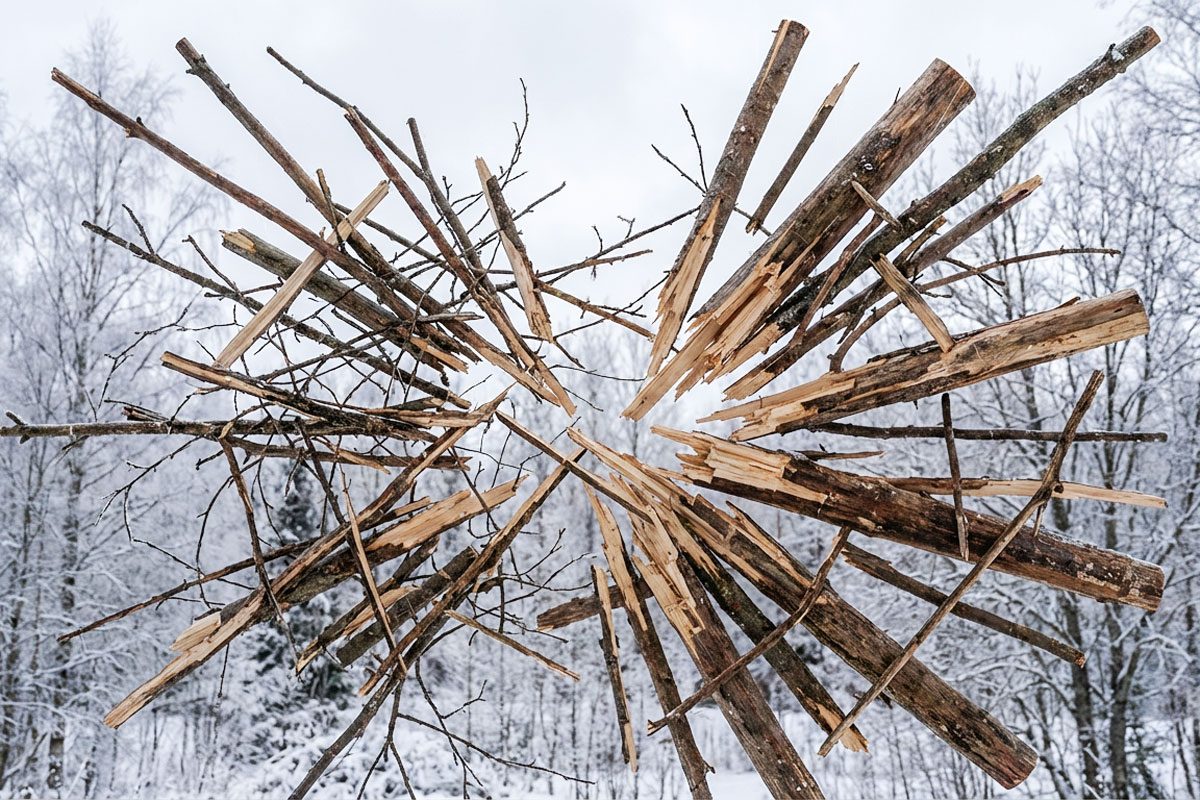
What to know before the extreme cold settles in.
Over the past few days, rumors have spread on social media that parts of the country may see trees explode in their neighborhoods due to snow and extreme cold. At first glance, this might have sent shivers down your spine and provoked feelings of panic, however, it’s important understand whether or not trees can really explode in extreme cold. Spoiler alert: just because social media says one thing that doesn’t mean it’s necessarily true.
Ahead, we spoke with an arborist about the “exploding” trees phenomenon and what you need to know to prepare for the harsh weather conditions.
Can Trees Really Explode in Extreme Cold?
No, trees don’t really explode in extremely cold weather. “While extreme cold can cause visible damage to trees, there is no true explosive event occurring,” says Ryan Torcicollo, an arborist and a brand ambassador for Husqvarna’s H team. “The term is informal and misleading, and it exaggerates what is actually a physical stress response within the tree.”
“Exploding” Trees Phenomenon, Explained

The “exploding trees” phenomenon actually refers to the process known as frost crack.
“Trees contain a significant amount of sap within their tissues, and when temperatures drop rapidly, that internal moisture can freeze, expand and place stress on the tree’s structure,” Torcicollo tells FH. “Frost cracks occur when the bark and outer wood contract or split due to rapid temperature changes, sometimes producing a sharp cracking sound,” says Torcicollo.
A frost crack can sound like an explosion, which is likely where the phrase “exploding trees” came from. It’s important to know that, although the sound may be loud, it’s typically not dangerous to people in close proximity. “It’s the result of physical stress and structural weakness, not an actual explosion,” Torcicollo reiterates.
These cracks typically run down the back side of the tree towards the lower and middle sections, where most of the moisture is retained; however, they can extend to the branches in some cases. Also, certain trees are more susceptible to frost crack such as maple, birch, elm and sycamore trees, whereas oak and chestnut and typically more resilient to severe temperature changes, according to the Nashville Tree Conservation Corps.
Tips to Protect Your Trees
If your tree has developed frost cracks, there’s not much you can do once that has already happened aside give it time to heal and recover from the stress. That said, the most effective way to protect trees from harsh weather is with proactive care.
Maintain Your Trees
Torcicollo says that proper trimming, removing deadwood, and reducing overextended limbs can significantly lower the likelihood of failure during snow, ice, or wind events. This can particularly be important for those trees near homes, power lines, and high-traffic areas to help prevent damage.
Brace Your Trees
Depending on location and size, you might be able to cable and brace your trees to help maintain them. According to Torciollo, in some cases, structural support systems such as cables can help mitigate known defects and extend the life of otherwise healthy trees.
About The Experts
- Ryan Torcicollo is an arborist and a brand ambassador/member of Husqvarna’s H team. He has 17 years in the tree care industry and an International Society of Arboriculture (ISA) certified arborist.
Sources
- Nashville Tree Conservation Corps. “What Is Frost Cracking, and How Can You Prevent It in Your Trees?” 2025.